Labels, Claims & Rights·Explainer
What Happens to the Textile Exchange Labels on Your Clothes: The Materials Matter Transition, Explained
Textile Exchange is consolidating its familiar material standards (RWS, RDS, GRS, OCS and others) into a single Materials Matter Standard. Here is the published timeline — criteria released December 12, 2025; effective December 31, 2026; mandatory for Tier 4 audits December 31, 2027; all claims and labels transitioned by June 30, 2029 — what the labels on hang tags must show in the meantime, and how to check a certified claim yourself.
Contents
If you check clothing tags — a sweater/jumper labeled with the Responsible Wool Standard, a down jacket with the Responsible Down Standard, recycled material marked with the Recycled Claim Standard or Global Recycled Standard — you have been reading labels owned by Textile Exchange, a nonprofit standards body. Those labels are heading into a transition: the organization says it is "currently unifying and harmonizing our current suite of standards into the Materials Matter Standard, a voluntary sustainability standard for the production and primary processing of raw materials used in the fashion, textile, and apparel industry."
For a shopper, the practical question is not what the new standard says about farms and factories, but what happens to the labels you already rely on in the years between now and the mandatory date. The short answer, according to Textile Exchange: the current standards stay in use for an interim period, and the switch to new claims and labels happens later than the switch to the new production standard itself.
The published timeline
Textile Exchange lays out the transition in stages, each of which changes something different. Note the gap between when the production standard becomes mandatory (December 31, 2027) and when claims and labels must have moved over (June 30, 2029) — for nearly a year and a half, products will legitimately carry labels of both kinds:
- December 12, 2025 — the final Materials Matter Standard and its Claims and Labeling Policy were published.
- December 31, 2026 — the Materials Matter Standard becomes effective; organizations can begin to be audited to it or continue to be audited to the current standards.
- December 31, 2027 — the standard becomes mandatory; all Tier 4 audits from this date forward are conducted to the Materials Matter Standard. Textile Exchange states that organizations may continue using its current standards "until this date to ensure a smooth shift for certified sites globally."
- June 30, 2029 — all claims and labels must be to the Materials Matter Standard.
The claims rules change first
One claims-side date comes earlier than the production standard's timeline: September 27, 2026, when the updated Standards Claims Policy (TE-301-V1.4) — revised, per Textile Exchange, to align with upcoming legislation including the EU's Empowering Consumer Directive (ECD) — becomes mandatory for implementation. From that same date, the policy removes commitment claims: corporate commitments and sourcing/progress claims no longer sit in the allowed categories, and Textile Exchange says it is developing an approach to credible verification of such claims to be published before then. So a brand talking about "being committed to" a standard is following a rule set that changes before any hang tag does.
What a certified product label is supposed to show
While the current standards remain in force, Textile Exchange specifies what a certified product label should contain. Under the Standards Claims Policy, a product-related claim — which can appear on the product (hang tag, product label) or off it (catalog, ecommerce description) — is expected to include:
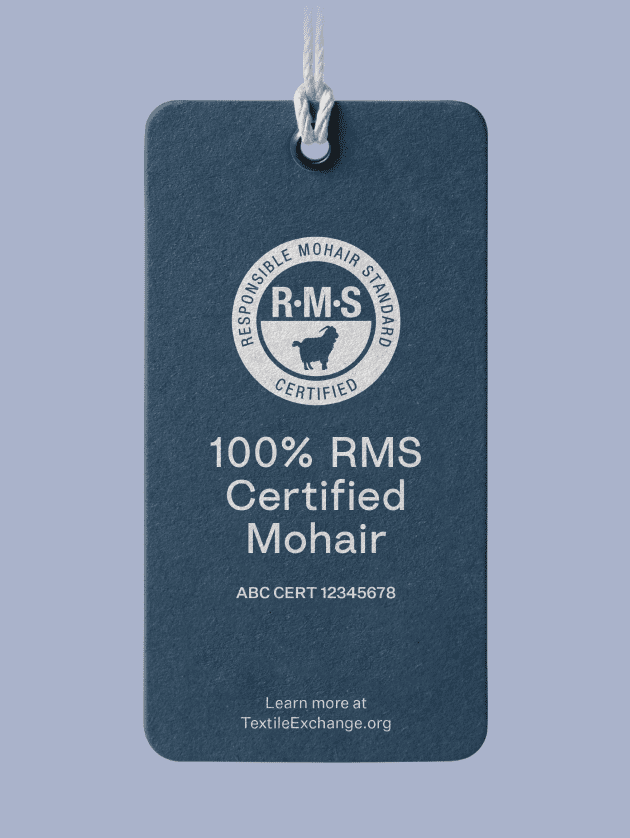
- The standard logo, conforming to the Standard Logo Use Specifications.
- The percentage of certified material in the product, with some exceptions referenced to the policy.
- The brand's license number or TE-ID, as on the valid scope certificate.
- The name of the responsible certification body.
Textile Exchange gives an example of how this can read in one sentence: "This product contains 50% RWS certified wool, certified by ABC Cert 12345678." Product-related claims are not approved by Textile Exchange itself — they must be submitted to and approved by the certified organization's certification body. For the responsible-fiber labels (RDS, RWS, RMS, RAS), the updated policy also recommends informational statements alongside "responsible" claims for clarity.
How certified content stays verifiable in the meantime
A claim is only as good as the paper trail behind it. That trail runs through the Content Claim Standard (CCS), Textile Exchange's chain of custody framework, which requires clear documentation for receiving, processing and transferring certified materials and is based on scope and transaction certificates forming an independently verified audit trail across the supply system — most applicable to Tiers 3–0, including traders, manufacturers and brands. The CCS is itself being revised (to v3.1), with objectives including alignment with the Materials Matter Standard and adapting to what Textile Exchange calls "the changing European Union (EU) policy landscape."
What a label does and does not tell you
A Textile Exchange label is a certification claim, not a quality assessment. The current standards are material-specific, and Textile Exchange's short descriptions point at material issues: the RWS, for instance, is described as improving "the welfare of sheep and the land they graze on," and the GRS as ensuring recycled products "are processed in a more climate-friendly way." Nothing in those one-line descriptions speaks to fit, durability or construction. Auditing and certification are handled by more than 30 third-party certification bodies overseeing some 90,000 sites; Textile Exchange writes and owns the standards, and certification bodies audit and issue scope and transaction certificates. Since Textile Exchange describes Materials Matter as a voluntary sustainability standard, moving to the new standard is not something the organization itself presents as a legal mandate on brands — though it says it is aligning its claims policy with the EU's ECD.
If you want to check a certified label yourself, you can refer to the Standards Claims Policy for the full requirements: look for the elements listed above — logo, certified percentage, license number or TE-ID, and certification body name; a label missing all identifying references is harder to verify. Textile Exchange also offers public tools to find a certified company, find a certifier, and find a TE-ID, and its transition timeline is published on its Standards and labeling pages — dates can change, so check the current versions there rather than relying on this article.
From the source
Written from the pages listed above and checked by the editors. Spotted a mistake? Write to us: corrections keep the address and the first publication date.
Read next
More in LabelsHow to Return Clothes to ASOS from the US: The 28-Day Window, Guest Fees, Final Sale Exclusions and Refund Timing
A step-by-step guide to returning an ASOS order from the US, as the retailer's customer-care pages state the rules: the 28-day return window from delivery, free tracked returns for account holders via UPS Ground, the $4.95 fee deducted from guest refunds, the no-exchanges refund policy, Final Sale exclusions, condition inspection, packing rules and refund timing. Per ASOS customer-care pages as read on 5 October 2026; policies change, so check the current page before ordering.
Labels·What the rule saysEU··4 min
What the Rule Says (EU): The Revised Waste Framework Directive and Mandatory EPR for Textiles and Footwear — In Force 16 October 2025
The EU's targeted revision of the Waste Framework Directive entered into force on 16 October 2025, introducing common EU-wide rules for extended producer responsibility (EPR) schemes for textile and footwear products. Producers will pay a fee for each item they place on the market, with fees eco-modulated based on sustainability criteria such as durability and recyclability, drawing on criteria developed under the Ecodesign for Sustainable Products Regulation. The revision also sets new rules for how separately collected textiles must be treated and sorted. Member States have 20 months to transpose the Directive and 30 months to establish their EPR schemes, so the direct effects on shoppers will arrive gradually as national laws change. This explainer summarizes what the rule says, in the Commission's own words, and how the reader can track implementation.
Labels·What the rule saysUS··6 min
What US Law Requires on Clothing Labels: Fiber Content, Country of Origin and Dealer Identity Under the Textile and Wool Acts
Under the US Textile and Wool Acts, most textile and wool products sold in the United States — per the FTC's guidance — must carry a label listing fiber content, country of origin and the manufacturer or dealer identity. This explainer walks through what the FTC requires, what the exceptions are, and how a shopper can check a label's claims.