Labels, Claims & Rights·ExplainerEU
What the EU Ecolabel on Clothing and Textiles Actually Certifies — Criteria, Validity Through 2028 and the Ongoing Revision
The EU Ecolabel is the European Union's official voluntary label for environmental excellence, and it covers both textile products and footwear. Based on the European Commission's own product-page material, we explain what the label guarantees for textiles and shoes, which criteria decisions currently apply, how long those criteria remain valid after the 23 December 2025 amendment, and what the ongoing revision means for shoppers.
Contents
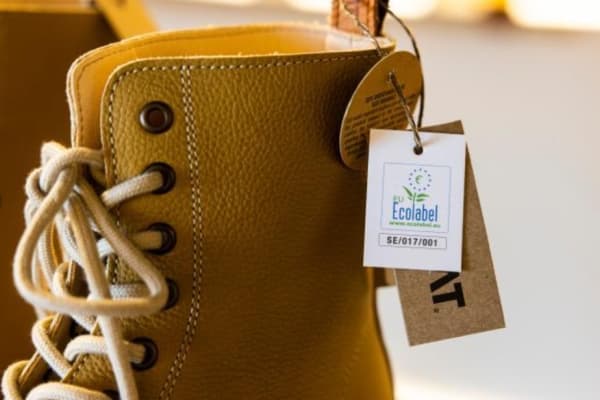
A flower logo with green leaves on a sweater tag, a pair of jeans or a box of sneakers/trainers is easy to overlook, but it is not just another brand seal. The EU Ecolabel is described by the European Commission as "The official European Union voluntary label for environmental excellence." That matters for shoppers because it is a public, criteria-based label run at EU level, not a private certification scheme owned by an industry body.
The Commission's clothing and textiles page presents the label as a way to find environmentally friendlier products on the European market. In its words, the EU Ecolabel on clothing and textile products "offers a reliable way of identifying high performing environmentally friendly textile and footwear products that are available on the European market." Unlike mandatory labels — such as the fibre-composition labelling required on textiles sold in the EU — the Ecolabel is voluntary, so its presence on a product is the manufacturer's choice rather than a legal obligation.
What the label guarantees for textile products and footwear
The guarantees differ slightly between the two product groups, and the Commission states them separately. For textile products — a group that includes textile clothing and accessories, interior textiles, fibres, yarn, fabric and knitted panels — the label guarantees the following, in the Commission's own phrasing:
- More sustainable fibre production
- A less polluting production process
- Strict restrictions on the use of hazardous substances
- A long-lasting final product
For footwear, the product group covers all kinds of school, casual, town, sports, fashion, infants and indoor footwear. Here the Commission lists guarantees of sustainable management of natural origin raw materials, reduced pollution in production processes, a minimised use of hazardous substances, and products tested for durability. Note the practical difference: for footwear, durability is described as tested; for textiles, the guarantee is phrased as a long-lasting final product. In both cases these are the Commission's stated guarantees, not independent quality checks by this publication.
What the label does not claim to be is a garment-care, repair or fit standard. The guarantees concern how fibres are produced, how the product is made, which hazardous substances may be used, and durability — not how an item should be cared for or how a size will run. For care instructions and fibre content, the mandatory textile labelling on the garment remains the reference point.
The criteria behind the flower — and their validity through 2028
A label is only as concrete as its criteria document. For textile products, the current criteria are set out in Commission Decision (EU) 2014/350 of 5 June 2014, with a consolidated text also available. For footwear, the current criteria are Commission Decision (EU) 2016/1349 of 5 August 2016. Each textile product group has a factsheet summarizing the criteria "in a nutshell," and applicant user manuals are published for licence holders.
The validity period matters when you read a tag. The criteria for both product groups were extended by an amendment of 23 December 2025 "as regards the prolongation of the EU Ecolabel criteria validity period," and the stated validity date is 31 December 2028. That means criteria adopted in 2014 (textiles) and 2016 (footwear) still governed the label after that amendment, though they will eventually be replaced by revised criteria.
The ongoing revision — and why it matters before you shop
For both the textile and footwear product groups, the Commission lists the status of the criteria revision as on-going. In practice, that means the requirements behind the flower are being reworked, and a future decision can change what the label guarantees. Until revised criteria are adopted, products are assessed against the 2014 and 2016 decisions as extended to the end of 2028. The Commission also publishes background material for each group — a preliminary report and a final technical report for textiles, and a background report plus a 2016 final technical report for footwear — which is where the reasoning behind the criteria is documented.
How to check what a specific label claim means
If you want to verify an EU Ecolabel claim on an item you are considering, the Commission's clothing and textiles product page names the applicable criteria decisions, the validity date and the revision status for each product group. For details beyond the summary on that page — the exact substance restrictions, production limits and durability tests — the published criteria decisions and the applicant user manuals are the operative documents. Because criteria can change and validity dates are set by amendment, check the current documents before relying on any specific guarantee, and where a question remains, the Commission offers a helpdesk contact form for product-group questions.
From the source
Written from the pages listed above and checked by the editors. Spotted a mistake? Write to us: corrections keep the address and the first publication date.
Read next
More in LabelsWhat Gore Says Its Certifications Cover: bluesign®, OEKO-TEX STANDARD 100 and GRS on GORE-TEX Products, as the Brand States Them
Gore, the maker of GORE-TEX fabrics and laminate, describes three third-party certifications on its own blog: bluesign®, OEKO-TEX® STANDARD 100 and the Global Recycled Standard (GRS). This profile collects those brand-attributed statements, including the share of shipped Fabrics volume the brand reports as certified, where the figures stop, and how you can check certifications on a product you are considering.
Labels·What the rule saysUK··5 min
What the rule says (UK): the DMCC Act 2024 ban on fake and hidden incentivised reviews — and what it means when you read clothing and shoe reviews
The UK's Digital Markets, Competition and Consumers Act 2024 adds prohibitions on submitting or commissioning fake reviews, reviews that conceal an incentive, and publishing reviews in a misleading way. A reader's guide to what the Act's Explanatory Notes say, and how to read clothing and shoe reviews with it in mind.
Labels·What the rule saysEU··4 min
What the Rule Says (EU): Directive (EU) 2024/1799 Promoting Repair — What It Requires, Since When, and What It Covers
An explainer of the EU's Directive on repair of goods, per the European Commission's page: adoption and application dates, the Annex II scope mechanism, the repair-based guarantee extension, the European Repair Information Form, national repair-promotion measures, and what the rule, as the Commission describes it, names for clothes and shoes.