Labels, Claims & Rights·What the rule saysUK
What the Rule Says (UK): The CMA Undertakings From ASOS, Boohoo and George at Asda on Green Claims in Fashion
In March 2024 the UK's Competition and Markets Authority accepted formal undertakings from ASOS, Boohoo and George at Asda on how they label and promote environmental claims. Here is what the brands agreed to, the legal status of that agreement, and what shoppers can check for themselves.
Contents
If you shop for clothes online in the UK, you may have seen labels like 'eco', 'responsible' or 'sustainable' on product pages, alongside leafy imagery and 'recycled' filters. In March 2024, three well-known fashion retailers — ASOS, Boohoo and George at Asda — signed formal agreements committing them to an agreed set of rules around the use of green claims. The agreements are not a new law: they are undertakings given to the Competition and Markets Authority (CMA), the UK consumer-competition regulator, after an investigation opened in July 2022.
This explainer covers what those undertakings require, what they do not do, and how a UK shopper can check whether a product page actually follows them. It is about the UK only; the EU has its own rules on green claims, described elsewhere on this site.
What the brands actually agreed to
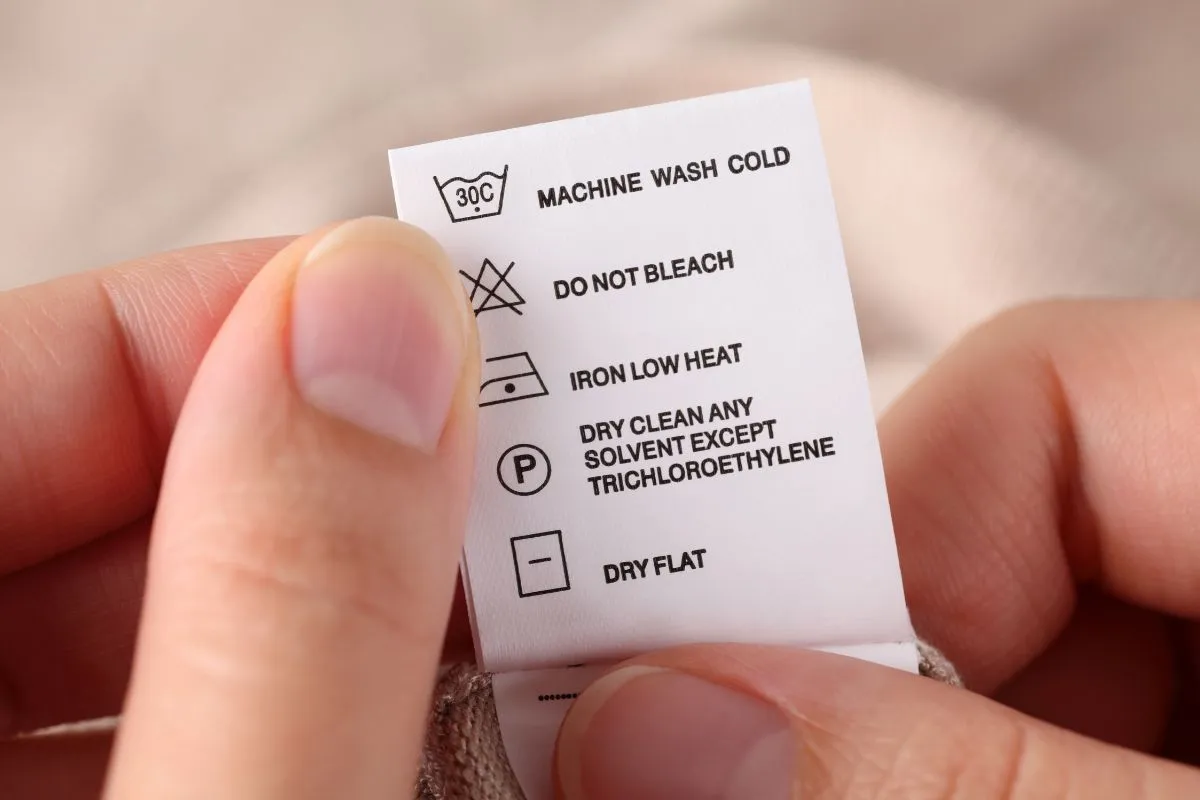
The CMA lists an agreed set of rules in its summary of the undertakings. The most concrete requirements concern fabric labels: instead of vague words like 'eco' or 'responsible', materials in green ranges must be described specifically, and the share of recycled or organic fibers must be shown where shoppers can see it. A product cannot be called 'recycled' or 'organic' unless it meets certain criteria.
The undertakings also touch the design of the shopping experience itself, not just words on a label — a product, for instance, cannot be marketed or labeled as part of an environmental range unless it meets all the relevant criteria:
- Green ranges: the criteria for what counts as an environmental collection — such as Boohoo's 'Ready for the Future' or George at Asda's 'George for Good' — must be clearly set out, including any minimum requirements like a percentage of recycled fibers.
- Imagery: 'natural' imagery such as green leaves, logos or icons must not suggest a product is more environmentally friendly than it actually is.
- Filters: a 'recycled' filter should show only items meeting the filter requirement, for example trousers made from predominantly recycled materials.
- Targets: claims about environmental targets must sit behind a clear, verifiable strategy, with the target's aim, date and how it will be pursued accessible to customers.
- Accreditations: statements about schemes and standards must make clear whether they apply to specific products or to the firm's wider practices.
All three firms must also report regularly to the CMA on how they are complying, alongside internal process improvements.
What the undertakings do not do
First, they are voluntary agreements made without any admission of wrongdoing. The CMA's own note says it should not be assumed the firms breached the law — only a court can decide that. So these are commitments on future practice, not rulings that past claims were illegal.
Second, they bind the firms that signed them. Underlying law — the Consumer Protection from Unfair Trading Regulations 2008 (CPRs) — is the key piece of consumer protection legislation relevant to this investigation, and the CMA has urged fashion retail businesses to review their claims in light of the benchmark, including via an open letter dated 27 March 2024. But other brands have not signed undertakings, even though the CPRs contain prohibitions against misleading actions and misleading omissions.
Third, each undertaking is tailored to the individual business model, so the fine detail differs between ASOS, which sells through its own site, Boohoo's group of websites, and George at Asda, which sells online and in store.
Status and timeline
The investigation opened on 29 July 2022 to scrutinize environmental claims about fashion products, including clothing, footwear and accessories, with concerns about broad, vague language that could make collections seem more environmentally sustainable than they are, and potentially misleading statements about accreditation schemes. It closed on 27 March 2024, when the undertakings were accepted. On 18 September 2024 the CMA also published a sector-wide compliance guide for fashion businesses, drawing on the investigation's conclusions and the Green Claims Code principles.
The signed undertakings themselves are available as PDFs on the CMA's case page, dated 27 March 2024, alongside the open letter to the sector.
What shoppers can reasonably expect
For these three sellers, the practical changes are: specific fabric terms rather than bare 'eco' or 'sustainable'; visible recycled or organic fiber percentages; published criteria for named environmental ranges; honest filters and restrained imagery; and checkable detail behind any environmental targets. CMA chief executive Sarah Cardell said shoppers can now have confidence in the green claims these businesses make — that is the regulator's stated expectation, and the compliance reports are meant to keep it current.
The limits are worth repeating: the undertakings are not law binding other retailers, they involve no finding of breach, and their reporting sits inside the CMA's compliance process. For other UK fashion businesses, the CPRs and the Green Claims Code — plus the CMA's fashion compliance guide from September 2024 — are the applicable framework.
To check a claim yourself, you can take a few practical steps:
- Look for the specific fabric statement and fiber percentage: a 'recycled' or 'organic' claim should say how much and be easy to see.
- Open the criteria page for any named green range and see whether minimum requirements are spelled out.
- Run a 'recycled' filter and spot-check whether listed items really are predominantly recycled.
- For an accreditation or a climate target, follow the linked explanation: what it covers, by when, and how it will be reached.
- If a claim looks misleading, you can report your experience to the CMA at misleadinggreenclaims@cma.gov.uk, as the case page invites.
Everything above rests on the CMA's two published pages — the press release of 27 March 2024 and the closed case page — and the signed undertaking PDFs they link are the primary documents. To verify for yourself, open the CMA case page, compare a product page's fabric statement, range criteria and filters against the quoted rules, and check the guide dated 18 September 2024 if you want the sector-wide standard.
From the source
Written from the pages listed above and checked by the editors. Spotted a mistake? Write to us: corrections keep the address and the first publication date.
Read next
More in LabelsLabels·What the rule saysEU··4 min
What the Rule Says: The EU Ban on Destroying Unsold Clothes, Shoes and Accessories from 19 July 2026
From 19 July 2026, EU rules under the Ecodesign for Sustainable Products Regulation prohibit large companies from destroying unsold apparel, clothing accessories and footwear, with medium-sized companies following in 2030 and small and micro-businesses exempt. Destruction remains permitted only in limited cases — unsafe or damaged items, counterfeits and intellectual-property infringements, or items rejected by charities — when companies provide proof and publish annual reports. National authorities enforce the ban with fines, and companies must keep records for five years. Here is what the rule covers, what it does not, and how to verify it.
Labels·What the rule saysEU··4 min
What the Rule Says: The EU Digital Product Passport for Textile Apparel — What the ESPR Requires and the Planned Timeline
A regulation explainer for clothes buyers: the EU Digital Product Passport, its legal basis in the Ecodesign Regulation (ESPR) (EU) 2024/1781, what a textile passport may contain under the draft framework, who the requirements cover, and the indicative timeline (planned textiles delegated act in Q4 2027). All textile-specific dates and content are still indicative, since the delegated act has not been adopted.
Labels·What the rule saysEU··4 min
What the Rule Says: The EU Green Claims Directive — the Proposed Rules on Substantiating Environmental Claims, and Why They Are Not Law Yet
In March 2023 the European Commission proposed a Directive on substantiating and communication of explicit environmental claims (the Green Claims Directive). On the Commission's page as reviewed for this article, its status is still listed as “Pending”, meaning it is a proposal, not rules in force. This explainer covers what the proposal would require — science-based substantiation, independent verification and governance of labeling schemes — how it fits with the EU's textiles strategy, and what shoppers can rely on today.