What KEEN.DRY Is: How the Brand Describes Its Waterproof Membrane, and Waterproof vs Water-Resistant vs Water-Repellent
A source-based explainer of KEEN.DRY, drawn from the brand's own February 10, 2020 explanation: an internal membrane described as a thin bootie that keeps water out while letting vapor escape, the brand's distinction between waterproof, water-resistant and water-repellent materials, its PFAS-free repellency treatment, and its own account of third-party flex testing to a 50,000-flex internal standard. All claims are attributed to KEEN as the brand states them.
Contents
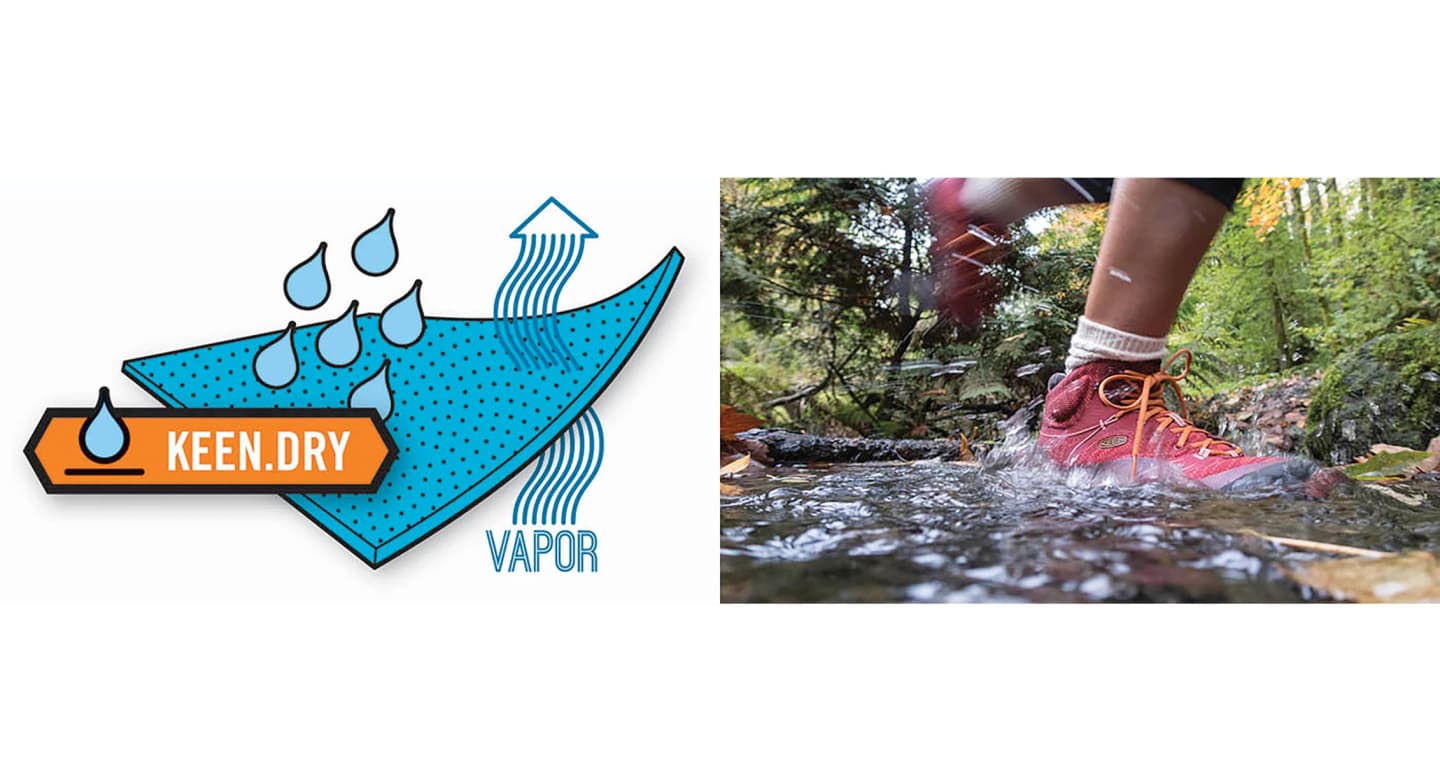
Waterproof is a word shoppers meet on hiking footwear labels, and for one brand's shoes its meaning is defined by that brand. KEEN defines its own system in a blog post, KEEN.DRY: Waterproof Your Rainy-Day Hikes, published on February 10, 2020. According to that post, KEEN.DRY is not a coating on the outside of the shoe but a membrane that works from within.
As the brand puts it, waterproof technology "is actually a membrane that seals out water from the inside. Imagine an ultra-thin 'bootie.' There's no place for water to get in." In other words, the shoe is built around a sealed inner layer, so water that reaches the membrane should not pass through to the foot. KEEN also describes how the layer handles moisture from the inside out: the bootie uses "microscopic holes that are big enough to let vapor escape without letting water in." That is the brand's account of how it balances water protection against breathability, and KEEN acknowledges a tradeoff: "You do sacrifice breathability when you choose a waterproof boot or shoe."
Waterproof, water-resistant, or water-repellent
The same brand post defines three terms for its own products:
- Water-resistant means, per KEEN, that a material won't easily absorb water — wool is the brand's example — but "Over time or in heavy rain, water can still get through."
- Water-repellent means the material "has been treated on the outside so that water beads up, adding an extra level of water-resistance."
- Waterproof, in KEEN's usage, "means that water isn't able to seep through because of our KEEN.DRY bootie on the inside."
- The brand adds that for its repellent treatment it uses "a water repellent that is PFAS-free for less impact on the environment."
In this article's reading of the quoted definitions, the three labels describe progressively more resistance but are not the same promise: a water-resistant material can eventually soak through; a repellent finish makes water bead off the surface but says nothing about what happens if water stays in contact with the material; and a waterproof membrane, in KEEN's description, is a physical barrier inside the shoe. These definitions are how KEEN frames its own products — for other brands, check that brand's own help or care pages to see how it defines the same words. The brand's February 10, 2020 post, cited throughout this article, is also the only source for the current site instructions mentioned later; site pages and product pages can change.
The flex test, as the brand describes it
KEEN's post also answers the question "How is it tested?" According to the brand, "All styles that use KEEN.DRY are randomly tested by a third party using a flex test in water." The method KEEN describes: a sensor is placed inside the shoe, the test simulates walking through water, and if the sensor detects moisture at any point, a red light comes on and the test stops.
The brand gives two flex figures. Per KEEN, "Our shoes must exceed the industry standard of 15,000 flexes to be classified as waterproof. Our own standard is much higher: 50,000 flexes." Both figures are the brand's stated numbers and its own characterization of the industry standard, so treat them as KEEN's account of its testing rather than an independent measurement.
KEEN says the outside treatment is not permanent
One practical point from the same post: the membrane is inside, but the water-repellent finish on the outside is not permanent, as the brand describes it. KEEN writes that "Over time, the water-repellent finish on your boots can become less effective," and suggests checking whether water still beads on the surface: "If you notice water no longer beads on the outside of your boot, it could be time to reinforce the water repellency." As an example, the brand says it likes Nikwax waterproofing spray and wax "because it is PFAS-free." A repellent top-up restores the beading behavior; it is not, by itself, what keeps water out of the membrane.
Do you need a waterproof shoe at all?
KEEN frames the question around usage: "It all comes down to how and where you hike." In KEEN's February 2020 view, long hikes where soggy feet can lead to blisters argue for waterproof shoes, while short hikes with a low chance of rain may not need them. On height, the brand notes that "A mid height hiking boot will give you more protection than a low hiking shoe," because the extra height reduces the risk of water getting in through the collar. It also points to wool socks, which it says naturally wick moisture, and to waterproof gaiters as an add-on outside the shoe itself.
Identifying KEEN.DRY styles when you shop
For readers who want the membrane specifically, the brand's February 2020 post describes two ways to find it on KEEN's website as that site stood at the time (UI may have changed since; check the current site):
- Use the "Filter" control and choose KEEN.DRY under Technologies.
- Alternatively, look for "{waterproof}" or "{WP}" in the style name — per KEEN, "if you see a KEEN style with “waterproof” or “WP” in the name, it has the KEEN.DRY membrane."
When you shop for waterproof footwear from any brand, a useful habit is to look for the brand's own help or care pages that explain how its technology is defined and tested, with the date you read them. A named membrane and a stated test, from the brand itself, give you something concrete to check, per the brand.
How to check this yourself
All claims in this article are attributed to KEEN's blog post KEEN.DRY: Waterproof Your Rainy-Day Hikes, dated February 10, 2020, which was live at keenfootwear.com as read on the retrieval date; URLs and pages can change. On a KEEN product page, look for the KEEN.DRY designation described above to see how the brand currently presents the membrane. When weighing the waterproof label on any shoe, read the brand's own testing and definitions section and note the date you read it, before treating the word "waterproof" as more than the brand's claim.
From the source
Written from the pages listed above and checked by the editors. Spotted a mistake? Write to us: corrections keep the address and the first publication date.
Read next
More in MaterialsWhat Hemp Fabric Actually Offers: What Patagonia Says About Growing It, Blending It and Its 'Iron Forge' Canvas
An explainer based on Patagonia's own material page: why the brand says it grows hemp with little irrigation, how it blends the fiber with organic cotton, recycled polyester and TENCEL lyocell, what the 'Iron Forge Hemp' abrasion claim says, and where the brand's account stops. All claims are the brand's, not independent tests.
What Coolmax Is: The Polyester Fiber in Darn Tough's Synthetic Socks, As the Brand Describes It
Coolmax is a brand of polyester engineered as a breathable, moisture-wicking alternative to wool. This explainer sets out what Darn Tough says about the fiber — how it is made, why the brand knits select Hike and Run socks from it, and the dated EcoMade recycled-content claim — with all comparisons to Merino wool kept as the brand's own position.
Next-Gen GORE-TEX and the ePE Membrane: What 'PFAS-Free' and 'Reduced Carbon Footprint' Mean on the Label — As Gore Describes It
Gore describes some newer GORE-TEX products as built on an ePE (expanded polyethylene) membrane rather than the brand's classic expanded PTFE. On Gore's own product pages, that change comes with two tagged claims — PFAS-free* and reduced carbon footprint** — each carrying asterisked fine print. This explainer sets out, as Gore describes it, what the ePE membrane is, what those label terms do and do not guarantee, and how to check a specific product, with every claim attributed to the brand.